City Post: Iraqi Kurdistan - Part Two (Guided Tour Day One)
- Jack

- Apr 19, 2024
- 10 min read
Updated: Apr 20, 2024
This is part two of my time in Iraqi Kurdistan. If you haven't checked out the first post, go give it a read!
--------------
I decided to do a guided tour of Iraqi Kurdistan for a few days rather than sit in Erbil for the full week. I did some research online to see if there actually were any guides to be had, because, after all, this was Iraq. While I knew there were YouTubers and journalists that had traveled to the area, I figured the tourism industry there was decidedly lacking.
And it was.
There were very few guides to speak of in my research. None of them really stuck out, but I found one of them consistently on travel websites: Iraqi Kurdistan Guide. Seeing as they were the ones that I saw the most, I decided to go with them. They didn't have a website, and my emails didn't seem to get through to them, so I reached out to them via WhatsApp. I mean, what's more official than that? (Ok, that's a bit unfair; by this time, I'd scheduled plenty of things via WhatsApp).
Luckily for me, they had a few days open right when I wanted to do the tour, so they scheduled me in for three days after Christmas. They sent me a detailed itinerary and cost breakdown for the trip. They preferred USD, but I'd been on the road for 6 months at this point, so I had to give them Iraqi Dinar (IQD). That sounds easy enough, but, if you read the first post, you know that the exchange rate situation in Iraq isn't exactly clear cut, so we basically agreed on an exchange rate for me to pay them in.
Govand was my guide. He picked me up from the hotel at 8h30 on the first day of the tour, and off we went. There I was, just me in a stranger's car driving through Iraq with nothing but an overnight bag and a bit of cash in my pocket. Talk about turning The Great Gallivanting into the adventure of a lifetime!
Our first stop was the border of Iraqi Kurdistan and Federal Iraq. This was where the autonomous region of Kurdistan met the rest of Iraq. One side had checkpoints manned by the Asayish (the Kurdish internal security service) and the other was manned by the Iraqi defence forces. This was as far West as I could go on my visa.
More interestingly, this was once the front line in the fight against Islamic State (IS). While the Iraqi Army fled in the face of an advancing IS force in 2014 (they literally ran away), the Kurds held their ground and prevented IS from invading Iraqi Kurdistan. The battle line moved only a few hundred meters at most at the worst point in the fighting, but the Kurds fought IS back to the line. As someone who had deployed with the military in the fight against IS, it was a surreal experience to be standing at the front line as a tourist years later.
From the front line, it was a short drive to the Mar Mattai monastery. The monastery was built in the 4th Century, and had been in constant use ever since. The monastery sat high on a hill and overlooked the Kurdistan / Federal border not far away. Govand told me that the night the fighting got close, all but one priest evacuated. The one that remained decided that he would stay true to his faith and the monastery in the face of Islamists hell-bent on destroying it. Luckily, IS was stopped on a hill short of the monastery, because they would surely have destroyed it had they taken it, and the priest would have been executed, likely beheaded.
To be fair to history, the Kurds have not always been friendly to the monastery. The monastery was established when Mar Mattai fled the Roman Empire. The Kurds have attacked and looted the monetary several times since the 1100s, in some cases severely damaging it and destroying important manuscripts. Nonetheless, the last recorded Kurdish attack on the monastery was in the 1700s, and the Kurds have since grown to cherish the monastery as a point of pride in their home.
The scenes from the monastery were amazing, especially in the rising sunlight. The road that led up to it made for a great scene as it led off towards Ninewah province. It wasn't lost on me, either, that the road is new (relative to the age of the monastery), and you could still see the path that its priests and visitors would walk to reach it.
The next stop on the tour was Lalish, home to the only Yazidi temple in the world. The Yazidis are a sect of Kurds who believe in the Yazidi religion, which, as best as I can describe it, is a combination of local beliefs, Judaism/Christianity, and some elements of Islam. They are also highly persecuted in the modern age, with both IS and the Kurdistan Worker's Party (PKK) targeting them for attacks, genocide, and, in the case of IS, sexual slavery of women and girls.
At the temple in Lalish, we were not allowed to wear shoes. It was a holy site, and even the temple's permanent residents never wore shoes inside. Keeping in mind that December in Iraqi Kurdistan is cold, the temple grounds included both the inside and outside spaces, so my feet would be freezing cold to the point of hurting by the time we left. Luckily, any time Govand wanted to explain things to me, he stood in a sunny spot so our feet could warm up. He told me that he runs tours year-round, and he came to Lalish on almost every tour, so he was used to the extreme temperatures. In the summer the ground was unbearably hot, and in the winter he had traipsed through the grounds in a foot of snow, all while barefoot.
He had also walked barefoot on tours during the Feast of the Assembly in October, which thousands to tens of thousands of Yazidis attend. Many Yazidis used this festival to complete their mandatory pilgrimage to Lalish, a key component of the Yazidi religion, and those who lived in the area would attend the festival every year. What does this have to do with Govand being barefoot? Well, because there would be so many people attending the festival, he and his guests would have to park at a nearby construction / oil station and walk to and from the temple. It was a 3.5 kilometer walk each way while barefoot.
The temple itself was basic. It was old and isolated in the mountains, so that was to be expected. Even so, there was still something remarkable about it. There were two natural springs which fed what I would describe as a version of baptistries. Only Yazidis were allowed into the rooms which housed these, as they were extremely sacred, so I did not get to actually see them. Govand told me that he knows the people there, so they left us alone, but if I would have come on my own, I would have had a minder making sure I didn't go inside.
I wouldn't have done so anyways, but it did give me something to think about. How many people go to religious sites completely unaware of pertinent beliefs and end up offending the religious authorities and local population in the name of tourism? I know that I have witnessed people wearing hats inside of Catholic cathedrals and have taken a bit of offence myself at the unwitting disrespect. I would later watch an unsuspecting British girl touch the top of a Hmong child's head thinking he was cute, which was considered extremely disrespectful to their beliefs. I could only imagine what it must have been like for the Yazidis, who barely survived IS's genocide against them, to have foreigners like me enter some of their most holy sites.
Speaking of which, the tomb of Sheikh Adi ibn Musafir was at the temple, as was the tomb of Sheikh Obakr, Musafir's brother. As a foreigner, I would not normally have been allowed anywhere near the second tomb, as it serves as an extremely holy site in the Yazidi religion (to the point where they even walk backwards away from it so as not to turn their back on his final resting place). Govand told me normally I wouldn't even be allowed in the room, but he had a good relationship with the temple, so they allowed him to take people inside. Even so, we stood just inside the doorway in the corner. This was a sacred place, and we had been graciously welcomed in, and we wanted to respect the Yazidis' sites and practices.
One final point here on Lalish, although there were certainly more aspects that I could discuss at length, as it was a fascinating place. Govand advised me to not step on the thresholds of doorways; I was to step over them. The Yazidis believed that angels inhabited the thresholds of every entrance, and to step on them was wholly forbidden. I felt like Govand trusted me a bit at this point, but he always watched as I crossed through doorways to make sure I didn't violate this tenet of their belief (he later told me that this would likely end with us being told to leave if I did).
From Lalish, we hit up a local restaurant for lunch and then headed to the Rabban Hormizd Monastery outside of Alqosh. If I thought the Mar Mattai monastery was beautiful, this one was amazing. The winding road leading to it was straight out of a movie or travel photo album. It was a steep uphill, and each new switchback provided new views looking out from the monastery. One of the gate guards at the bottom told us (well, told Govand, who told me) that he started walking it instead of driving to get exercise. That would certainly do it!
The Rabban Hormizd Monastery was a place of refuge for monks and priests during various periods of Kurdish rules. It had caves and tunnels built into the mountain that provided a place to hide during raids and periods of sectarian violence (while tolerant of differing religious views today, the Kurdish empires of old were not so welcoming, even exacting mass killings of Christians at times). Once upon a time, it was host to an extensive library of manuscripts which, unfortunately, were looted in the 1800s by Kurdish forces.
Fortunately, both the Catholic Church and the Kurdish people have since more or less reconciled and invested in restoration works of the monastery. Govand told me that the Asayish (the Kurdish internal security forces) even assigns its guards based on their religion as one way of contributing to the sites' preservation.
Upon entering, we found ourselves in the "new" sanctuary. Keep in mind, timescales in places like this were measured in centuries, not decades, so the "new" sanctuary was actually between 100 and 200 years old. Back in the original sanctuary, which was built more into the rock than the later additions, there were several tombs built into the wall. Each of these tombs had a different cross, but some crosses were missing. Govand told me that there are a lot of theories about where they are, with one of the most popular being that American forces looted them during the initial invasion of Iraq. I had to admit, while I would have liked to believe that wasn't true, there were no real rules for the conduct of war in Iraq back then, so it would not have surprised me in the least if they were in someone's personal collection or even a unit headquarters somewhere.
We ran into two other groups of tourists while at this monastery. This was surprising to me, because, well, this was Iraq. It also surprised Govand, because he didn't recognise their guides. The tour guide community in Iraqi Kurdistan was small, and they all knew each other, so he was intrigued (mainly because he wanted to ensure tourists receive a true picture of Kurdistan instead of some version a foreign guide might provide). It turned out the tourists were friends of the guide who was an instructor at a local school or university. The more important note for me was that they had brought their teenage sons with them. I couldn't imagine anyone I know, not even the craziest and coolest of parents, deciding to take their children on a trip to Iraq. On the one hand, I thought it somewhat foolish, but, on the other, it was really cool that these parents thought it important to bring their kids to a place which has such an important regional and worldwide history.
Well, it was getting late-ish, so we left Alqosh and headed to Duhok. Duhok was a predominantly-Christian community in Northern Iraq once upon a time. In the 20 years since the US invasion, it has becoming a sprawling city with high-rise apartments, universities, and even an amusement park. The First Sergeant I had worked with in the military had told me to check it out, because he had visited during the Surge (the name for the rapid build-up of US troops in Iraq during the Iraq Civil War). Even back then, he said it was full of people wearing western clothing who seemed wholly unconcerned about the war.
Before we hit up our hotel, Govand took me up a hill that overlooked the city. It had coffee shops, cafes, and locals just enjoying the sunset views. From the top, you could see Lake Mosul in the distance (formed by the Mosul Dam backing up the Tigris River). He told me this was a popular place for locals, and even the Arabs from the rest of Iraq, as a weekend getaway during the Spring and Summer. We didn't spend long there, but I could definitely see myself sitting up there for hours on end with a book, laptop, or good friends enjoying the scenery and good times. It was easy to see, too, that this place would be busy on a Friday night in just a few months time.
Our hotel was located near the Duhok Bazar. It was a really nice hotel, and only cost 53 USD for two rooms. Govand had given me the option of staying in a "nice" hotel or a "local place." I told him whichever was cheaper and he was comfortable with, because I didn't need a nice place just to sleep. Well, this "local place" was plenty nice! I had a HUGE bed, a great view, and a nice bathroom. The lobby was immaculate with plenty of couches, and there was even a large conference room. The staff there were also great. Absolutely ZERO complaints from me!
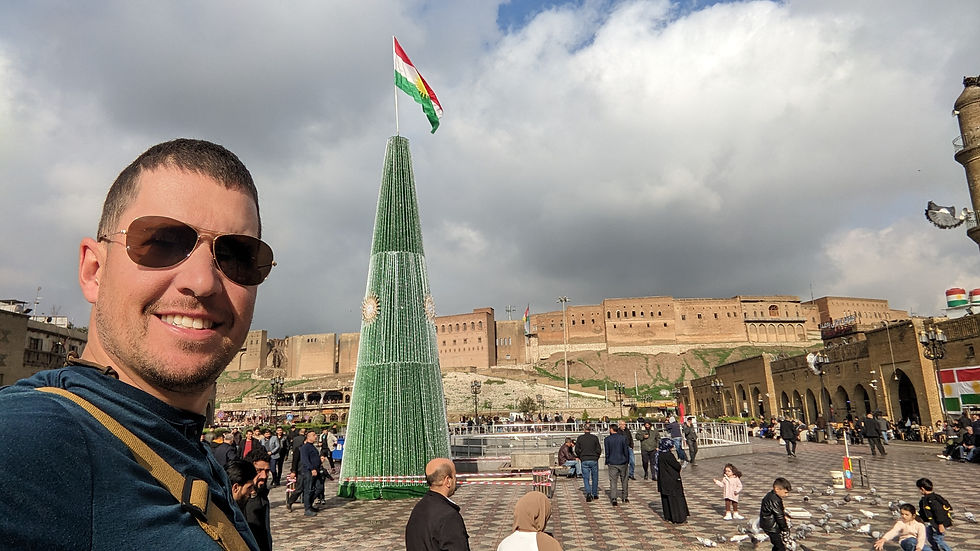
Because it was Christmas time, Govand took me over to a square where there was a small Christmas market set up after dinner. Just like back home, there were people who were selling homemade goods and sweets, and locals were there enjoying the night out. Just like in Erbil, there were Christmas lights and Christmas trees adorning the square. I commented on it to Govand, and he told me that, yes, Duhok was once a predominant Christian community, but Christmas is a Kurdistan-wide holiday. Sure, not all of them believed in the Christmas story, but it was still a time to enjoying everyone's company at the end of the year. This wasn't much different than in the US where even non-Christians partake in many of the same Christmas traditions as those who focus on the religious aspects.
After the market, we turned in for the night. We had a long day of driving the next day to see some pretty remarkable sights.


Comments